








I had just finished my morning sadhana – chanting, prayer and a few minutes of stillness, which always felt like punctuation marks adding nuance to the long sentence of life – and stepped out to bask in the silence of the morning.
The palace lawns at dawn felt like a different world from the night before. The same place that had throbbed with songs, dance and laughter just hours earlier was now washed in soft gold by the rising sun.
There’s something magical about silence. It isn’t just the absence of sound, it’s the presence of something deeper. When we sit in silence, it’s like looking into a mirror turned inward. We begin to see corners of our own hearts and minds that we didn’t know existed. At first, it can be uncomfortable – because in silence there are no filters, no makeup, no patching up, no performance for anyone else. It is just us, as we are.
But it is in these precious, unfiltered moments that true reflection begins. Silence gives us the courage to face what we often avoid – the fear tucked beneath our confidence, the fatigue hidden behind our busyness, the longing beneath our laughter. And it also opens the door to something greater – a connection with our own inner self.
Our mind is like a battlefield of thoughts. Desires clash with doubts, fears wrestle with hopes, expectations collide with reality, ego locks swords with humility. In the constant noise of responsibilities, deadlines and social pressures, we often don’t hear the battle inside. But in silence, the battlefield comes into view. And that is the first step to peace – not because the battle has ended, but because we stop identifying with every sword that swings. We become the witness, not just the warrior.
Spiritual practices like chanting, meditation or prayer can help us enter that silence more deeply, but sometimes simply walking in a quiet garden at dawn can be a spiritual act. Silence has its own language, if we dare to listen. And that is why our sadhana becomes the gentle rhythm of our day – a constant that keeps us anchored amidst all the change.
It was in that stillness, with the morning dew sparkling on the grass and the desert breeze brushing gently against my face, that I noticed I wasn’t alone.
Across the lawn, walking slowly with a steaming cup of chai in his hand, was Gaurav – Sanjana’s elder brother – whom I had briefly met the night before. He was dressed in understated casuals: a plain-grey T-shirt, navy track pants and running shoes. His hair was slightly tousled, as though he had just rolled out of bed, and his stride was unhurried, each step carrying the weight of his thoughts. When he looked up and noticed me, his smile was both warm and a little weary, like that of someone who had been up late not just celebrating but also reflecting.
“Swamiji! Early riser, huh?” he called out, lifting his cup in greeting. “No hangover from last night’s dance floor?”
I chuckled. “A monk’s best move on the dance floor is the exit. I escaped before anyone could pull me in.”
Gaurav laughed. “Smart! I wasn’t so lucky. I was dragged into some choreographed number. Half the time I was trying to remember the steps, and the rest of the time I was trying not to trip.”
We fell into step together, the gravel crunching softly beneath us. For a while, we simply walked in companionable silence, listening to the calls of the birds flitting across the morning sky.
Then Gaurav tilted his head slightly, as though weighing a thought, and gave me a sidelong glance. “You know, I’ve actually seen a few of your videos online.”
I raised an eyebrow. “And you still chose to walk beside me? Brave man.”
That drew a proper laugh from him. “No, really. One clip stuck with me – you spoke about how life sometimes pushes us into roles we never asked for, but that playing them with love makes us stronger. That one … felt like you were talking to me.”
I smiled. “Thank you for sharing that. You know, I often send these words out into the world like paper boats, not knowing if they’ll sink or sail. Hearing that one of them reached you safely, that’s my reward.”
Gaurav nodded slowly, swirling the chai in his cup. “Paper boats, huh? I like that. Some sink, some float … some get lost, some reach the shore.”
“And sometimes they land in places we never expected – like this conversation on a palace lawn after a late-night dance party.”
He chuckled. “Yeah, life has a way of surprising us like that. You put something out there, never knowing who’ll catch it.”
For a few seconds, he stayed quiet, as though mulling over whether to continue or not. “The funny thing is,” he murmured, “most people think of weddings as loud, bright, over the top. But mornings like these … they make you remember what’s beneath all that razzle-dazzle.”
I nodded. “Silence reveals what the noise hides.”
Gaurav exhaled, his breath visible in the morning chill. Then, for a moment, his gaze drifted past the lawns towards some place much further away.
“See, my parents died in a car accident when I was 21,” he began, his words slower, more deliberate now. “Sanjana was only 13 then. Overnight, I stopped being just her elder brother. I became parent, guardian, alarm clock, ATM, tuition teacher … everything.” He gave a wry smile. “Relatives swooped in and took what little we had. Only the house stayed with us. I was still pursuing my commerce degree, but I took up whatever jobs I could find to keep the house running. While my friends were partying, I was paying bills and fees.”
We continued to walk. A squirrel darted across the path just then, pausing for a moment with something clasped tightly in its mouth before scurrying up a tree. Gaurav’s gaze followed it briefly, and he gave a slight, ironic smile.
“That’s how it’s been for me,” he said. “Always carrying something in my mouth, in my hands, on my back … Never free to just be. And since my parents left this world, I never really thought of marriage or my own life. Sanjana became my life. She’s the reason I worked, sacrificed and stayed strong. So yeah, when you said in that video that the responsibility you never chose can become the very thing that shapes you, it … hit home.”
He walked a few more steps in silence, then added, almost as if he wanted to balance his admission with something lighter, “Look, I’m deeply grateful I could be there for Sanjana. If I had to do it all over again, I would. Not once have I allowed myself to complain about it, not once have I shown resentment. Ask anyone, and they’ll tell you that I’m the one who’s always cracking jokes, lightening the mood, being helpful. And that’s all true.”
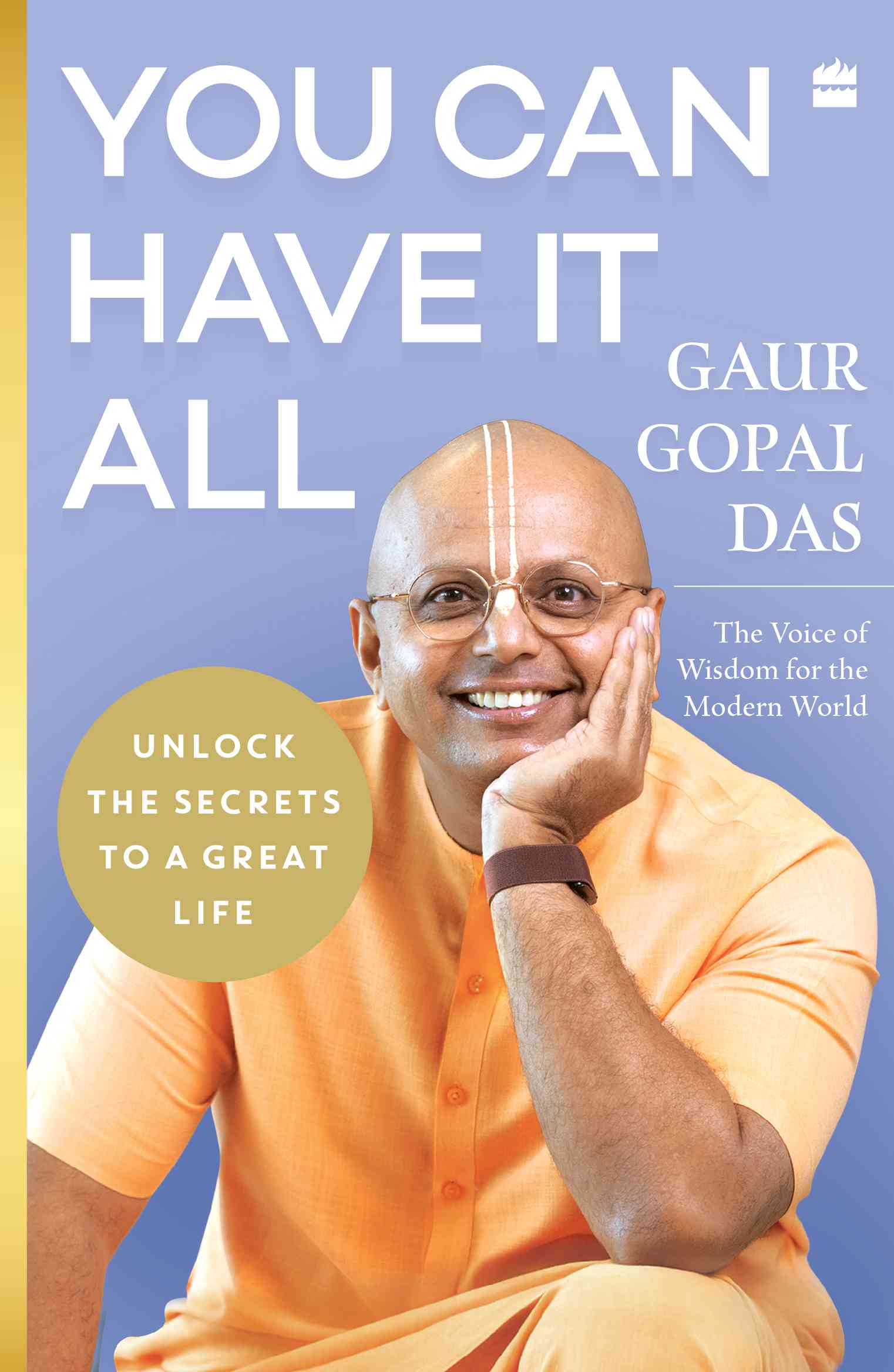
Excerpted with permission from You Can Have It All: Unlock the Secrets to a Great Life, Gaur Gopal Das, HarperCollins India.
